
Win STORM Help - Remote Commands


Win STORM is in beta stage. While we're debugging the application, please report any bugs you find through our Contact form.
Win STORM lets you run commands and scripts on your managed remote computers. This page documents those commands.
Overview of the Remote commands
Remote commands are commands you can send to a remote computer when working on our RMM system. There are quite a few command types available and we plan to add more as we update Win STORM.
Commands can be sent from the Remote PC management tab of the Remote monitoring Win STORM page.
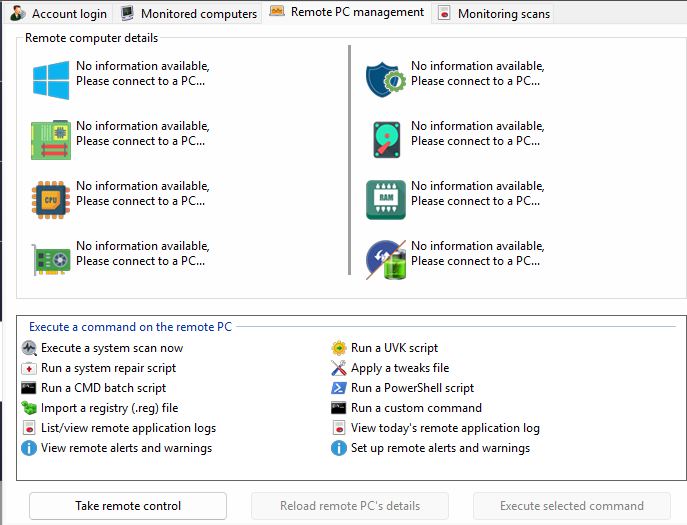
To run a command, simply double-click it on the list, or select the desired command and the press Execute selected command.
A progress box will display the operation's progress, and in the end, you get to know the command's exit code. Note that some commands may take long to execute or may need user interaction, and the remote computer needs to be connected to the RMM system in order to receive the commands.
Execute a system scan now
This command lets you start a system scan in the remote computer. You can choose the areas to scan, and also whether to wait for the command to finish execution, among other options.
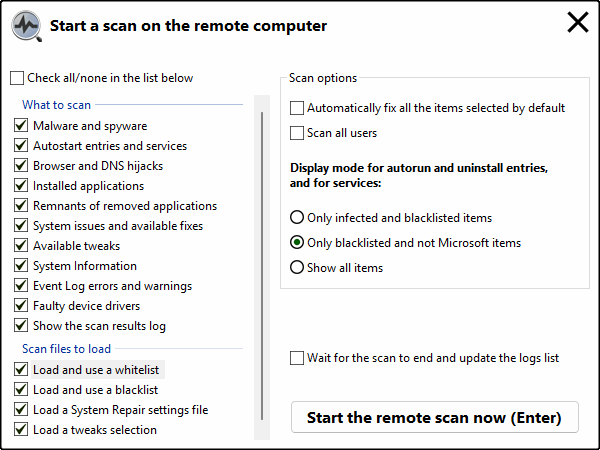
Select the areas you want to scan and the files you want to load.
Tick Automatically fix all the items selected by default, if you want all checked items to be automatically fixed.
Tick Scan all users, if you wish to scan all the users in the remote system.
Then select your preferred filtering option. Note that this option is only valid for the Autostart entries, Services and Installed desktop apps lists. It will not have any effect on the other lists' results.
- Only infected and blacklisted items - Select this option if you're only searching for malware and your own blacklisted items.
- Only blacklisted and non Windows items - This is the default option. Genuine Windows services, autostart entries and desktop applications are hidden.
- Show all items - If you select this option, no filtering is done, except for your white listed items.
Note that regardless of which option you select, white listed items are always hidden, and blacklisted items are always displayed.
Tick Wait for the scan to end and update the logs list, if you want to enable this function.
When ready, press Start the remote scan now (Enter) to start the remote scan. A progress box will spin while the scan is performed, and the list of remote scan logs is updated, if that option was enabled,
Run a UVK script
This command lets you send a UVK script to the remote computer and execute it remotely. UVK scripts can be created with the Log analyzer utility of the Utilities Win STORM page.
To begin, Win STORM asks you to indicate the path of the UVK script to send to the remote computer. Then, the Run a script remotely dialog box is displayed, similar to the picture below.
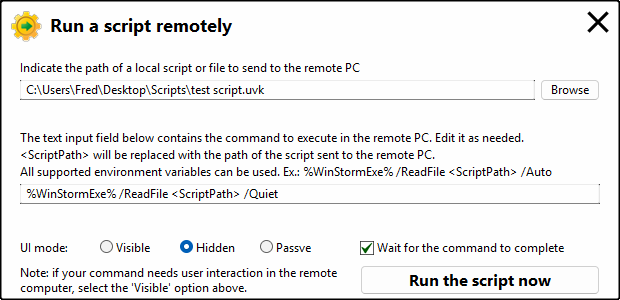
If you decide to run a different script, you can click the Browse button and indicate its location.
The full command is displayed in the text field near the middle of the dialog box. <ScriptPath> is placed instead of the script's path.
Before running the command in the remote computer, <ScriptPath> is replaced with the remote path of the script sent from the local computer, which is saved to a temporary file in the remote computer. This ensures the script's path is valid in the remote machine.
Select the desired UI mode when running the UVK script in the remote computer.
- Visible - Normal UI.
- Hidden - Quiet mode. No UI is displayed, no user interaction is needed, usually.
- Passive - Only progress is displayed, no user interaction is needed, usually.
If you tick Wait for the command to complete, the progress dialog box will spin until the command is fully executed remotely.
When ready, press Run the script now to start sending the script to the remote computer and then execute it. A progress box will show the operation's progress,
Run a system repair script
This command lets you send a UVKSR file to the remote computer and execute it remotely. UVKSR files are created from the System Repair utility of the Utilities Win STORM page.
To begin, Win STORM asks you to indicate the path of the UVKSR file to send to the remote computer. Then, the Run a script remotely dialog box is displayed, similar to the picture below.
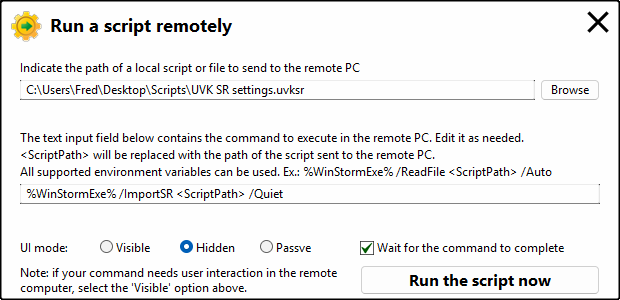
If you decide to run a different script, click the Browse button and indicate its location.
The full command is displayed in the text field near the middle of the dialog box. <ScriptPath> is placed instead of the script's path.
Before running the command in the remote computer, <ScriptPath> is replaced with the remote path of the script sent from the local computer, which is saved to a temporary file in the remote computer. This ensures the script's path is valid in the remote machine.
Select the desired UI mode when running the UVKSR file in the remote computer.
- Visible - Normal UI.
- Hidden - Quiet mode. No UI is displayed, no user interaction is needed, usually.
- Passive - Only progress is displayed, no user interaction is needed, usually.
If you tick Wait for the command to complete, the progress dialog box will spin until the command is fully executed remotely.
When ready, press Run the script now to start sending the script to the remote computer and then execute it. A progress box will spin while the operation is executed,
Apply a tweaks file
This command lets you send a .uvktweaks file to the remote computer and import it remotely. Tweaks files can be created from the Tools and tweaks utility of the Utilities Win STORM page.
To begin, Win STORM asks you to indicate the path of the .uvktweaks file to send to the remote computer. Then, the Run a script remotely dialog box is displayed, similar to the picture below.
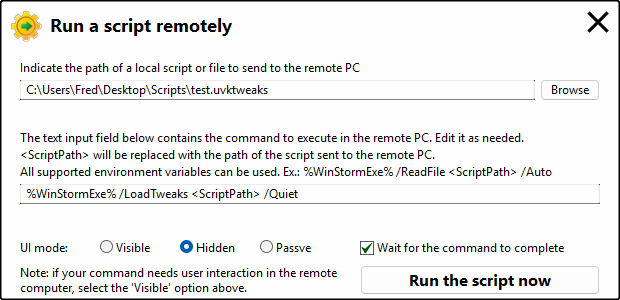
If you decide to send a different uvktweaks file, click the Browse button and indicate its location.
The full command is displayed in the text field near the middle of the dialog box. <ScriptPath> is placed instead of the uvktweaks file path.
Before running the command in the remote computer, <ScriptPath> is replaced with the remote path of the script sent from the local computer, which is saved to a temporary file in the remote computer. This ensures the script's path is valid in the remote machine.
Select the desired UI mode when running the script in the remote computer.
- Visible - Normal UI.
- Hidden - Quiet mode. No UI is displayed, no user interaction is needed, usually.
- Passive - Only progress is displayed, no user interaction is needed, usually.
If you tick Wait for the command to complete, the progress dialog box will spin until the command is fully executed remotely.
When ready, press Run the script now to start sending the script to the remote computer and then execute it. A progress box will spin while the operation is executed,
Run a CMD batch script
This command lets you send a batch script (.bat, .cmd) to the remote computer and execute it remotely. CMD batch scripts can be created using any plain text editor.
To begin, Win STORM asks you to indicate the path of the batch script to send to the remote computer. Then, the Run a script remotely dialog box is displayed, similar to the picture below.
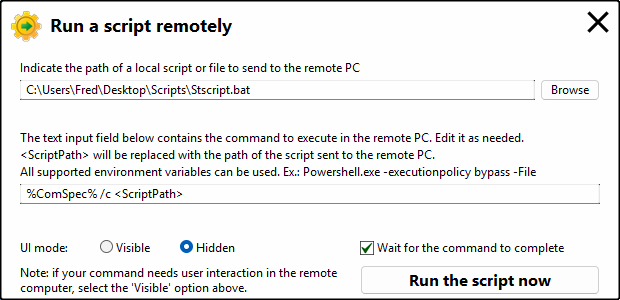
If you decide to run a different batch script, you can click the Browse button and indicate its location.
The full command is displayed in the text field near the middle of the dialog box. <ScriptPath> is placed instead of the script's path.
Before running the command in the remote computer, <ScriptPath> is replaced with the remote path of the script sent from the local computer, which is saved to a temporary file in the remote computer. This ensures the script's path is valid in the remote machine.
Select the desired UI mode when running the batch script in the remote computer.
- Visible - Normal UI.
- Hidden - Quiet mode. No UI is displayed, no user interaction is needed, usually.
If you tick Wait for the command to complete, the progress dialog box will spin until the command is fully executed remotely.
When ready, press Run the script now to start sending the script to the remote computer and then execute it. A progress box will spin while the operation is executed,
Run a PowerShell script
This command lets you send a PowerShell script (.ps1) to the remote computer and execute it remotely. You can create .ps1 files with PowerShell or any text editor.
To begin, Win STORM asks you to indicate the path of the PowerShell script to send to the remote computer. Then, the Run a script remotely dialog box is displayed, similar to the picture above.
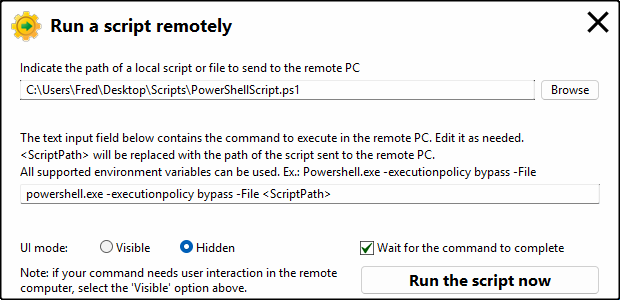
If you decide to run a different PowerShell script, you can click the Browse button and indicate its location.
The full command is displayed in the text field near the middle of the dialog box. <ScriptPath> is placed instead of the script's path.
Before running the command in the remote computer, <ScriptPath> is replaced with the remote path of the script sent from the local computer. The PowerShell script is saved to a temporary file in the remote computer.
Select the desired UI mode when running the script in the remote computer.
- Visible - Normal UI.
- Hidden - Quiet mode. No UI is displayed, no user interaction is needed, usually.
If you tick Wait for the command to complete, the progress dialog box will spin until the command is fully executed remotely.
When ready, press Run the script now to start sending the script to the remote computer and then execute it. A progress box is displayed, indicating the operation's progress
Import a registry (.reg) file
This command lets you send a REG file to the remote computer and execute it remotely. REG files can be created from the Windows registry editor (regedit.exe), or from the command line or terminal using the Reg export command.
To begin, Win STORM asks you to indicate the path of the REG file to send to the remote computer. Then, the Run a script remotely dialog box is displayed, similar to the picture below.
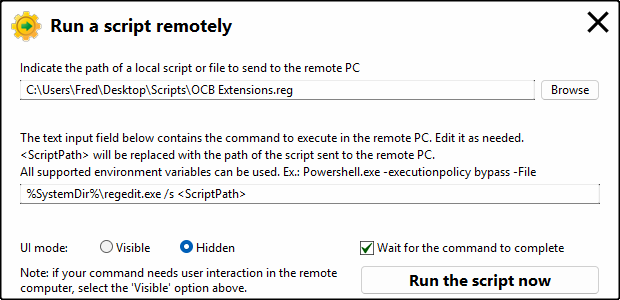
If you decide to run a different REG file, click the Browse button and indicate its location.
The full command is displayed in the text field near the middle of the dialog box. <ScriptPath> is placed instead of the REG file's path.
Before running the command in the remote computer, <ScriptPath> is replaced with the remote path of the REG file sent from the local computer. The REG file is saved to a temporary file in the remote computer.
Select the desired UI mode when running the script in the remote computer.
- Visible - Normal UI.
- Hidden - Quiet mode. No UI is displayed, no user interaction is needed, usually.
Tick Wait for the command to complete if you want. In this case, the progress dialog box will spin until the command is fully executed remotely.
When ready, press Run the script now to start sending the script to the remote computer and then execute it. A progress box is displayed, indicating the operation's progress
Run a custom command
This command lets you execute any command or script in a remote computer. The dialog box for this command is displayed below.
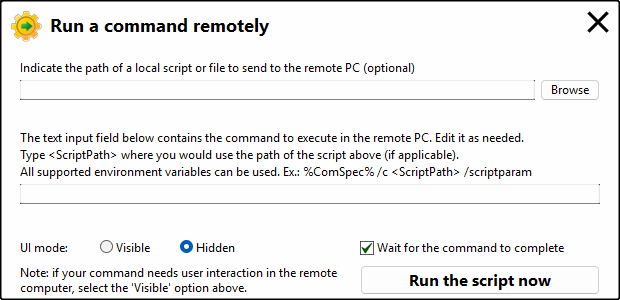
You can send a script or any file you want to the remote computer. In that case, click the Browse button and indicate its location. This is optional, if you don't want to send any file, just leave the path field blank.
Type the full command in the text field near the middle of the dialog box. If you're sending a script, specify <ScriptPath> where you would normally put the script's file path.
Before running the command in the remote computer, <ScriptPath> is replaced with the remote path of the script file sent from the local computer. The file sent is saved to a temporary file in the remote computer. This is only valid if you're sending a script.
Select the desired UI mode when running the script in the remote computer.
- Visible - Normal UI.
- Hidden - Quiet mode. No UI is displayed, no user interaction is needed, usually.
Tick Wait for the command to complete if you want that. In this case, the progress dialog box will spin until the command is fully executed remotely.
When ready, press Run the script now to start executing the command in the remote computer. A progress box is displayed, indicating the operation's progress
List/View remote application logs
Application logs contain all the actions performed using Win STORM in a computer. After successfully sending this command, a dialog box listing the remote PC's application logs is displayed, as shown in the picture below.
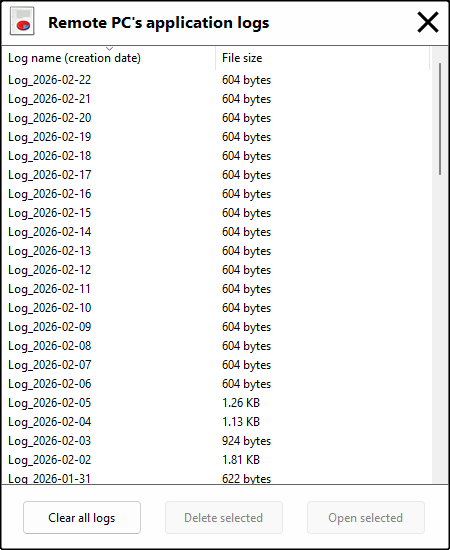
Select a log in the list.
Press Delete selected to remove the selected log from the remote computer.
Press Open selected to open the selected log in the Application log's dialog box. See the picture below for more info.
Press Clear all logs to delete all application logs in the remote computer. Note that this operation is irreversible.
Once you're done, close this window.
View today's application log
If you send a View today's application log command to a remote computer, or if you open a log from the remote application logs window, a dialog box similar to the one in the picture below is displayed.
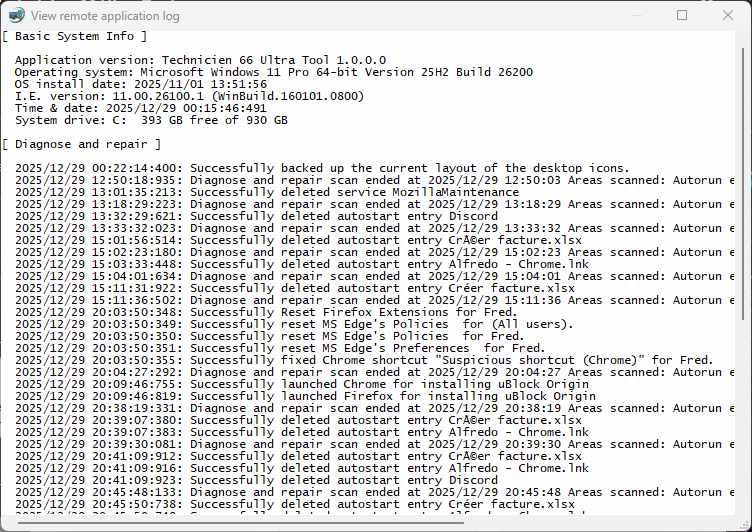
Once you're done with this log, close this window.
View remote alerts and warnings
Every time Win STORM displays alerts automatically, only the latest ones are shown. However, alerts are cumulated, saved to a text file so you can review them later. This feature lets you view and manage cumulated alerts and warnings on the remote computer.
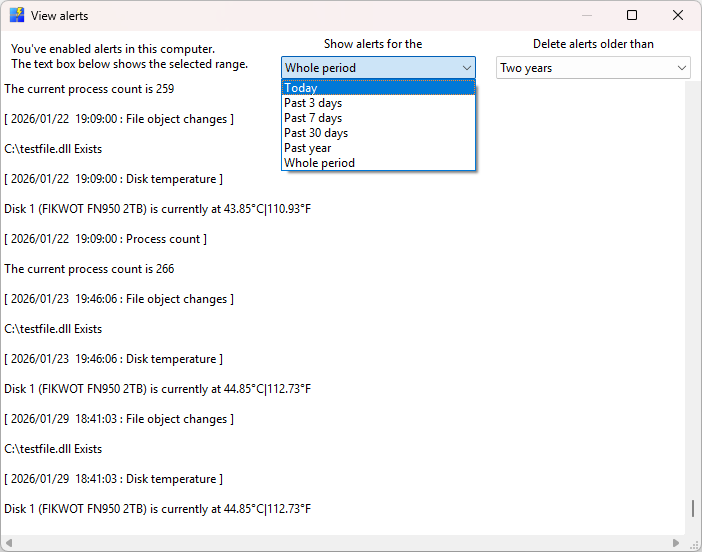
Select the period for which you want to see alerts and warnings for, in the top middle drop down box.
To delete old alerts, select the desired period to delete, in the top right drop down box. Win STORM will attempt to delete the selected range on the remote computer.
Once you're done, close this dialog box.
Set up remote alerts and warnings
Win STORM alerting system already supports many different alert types and we're constantly adding more. Please do tell us about alert types that should be added.
When you send this command, a dialog box similar to the one in the picture below is displayed, letting you set up remote alerts.
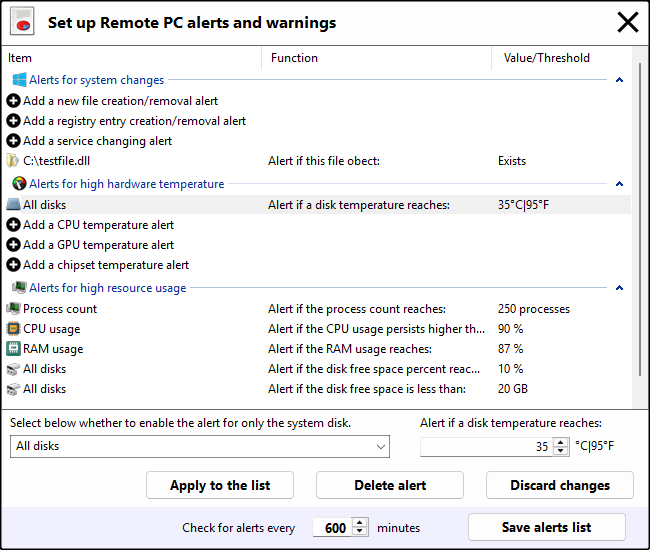
The list contains three groups:
- Alerts for system changes - Supports alerts for file creation/removal, registry entry creation/removal and service changes.
- Alerts for high hardware temperature - Supports alerts for high disk temperature. We're adding support for CPU, GPU and chipset temps.
- Alerts for high resource usage - Supports alerts for high number of processes, high CPU usage, high RAM usage, and low disk space, in percentage or in GB.
Select the desired item in the list. If you want to add a new alert, select the corresponding item with a "plus" sign. Otherwise, select an item that you want to modify or remove. The list shrinks vertically, and some controls appear at the bottom which let you set the desired data for the selected alert.
When you're done, click Apply to the list, to write the changes you've made on the selected alert to the list. This will not save the alerts list yet, See below.
To delete an existing alert instead, press Delete alert. Obviously, this is only valid for existing alerts.
If you don't want to apply any changes to the selected alert, press Discard changes instead.
Set how frequently the application should check for alerts and warnings, in the text input field after "Check for alerts every". This is the interval, in minutes that Win STORM waits between each time it checks for new alerts.
Once you're done, press Save alerts list. This will apply all the changes you've made to all the list to the remote computer
To discard any changes to the alerts list, close this dialog box by clicking the X button at the top right corner of the dialog box.
